Dec 26, 2025

Digital pollution is the default. Everyone publishes. Few systems prove. In AI search, “ranking” is no longer a position—it’s a permission: permission to be extracted, summarized, and cited.
Definition: AI SEO is the practice of making your content machine-understandable and machine-trustworthy through explicit entities, bounded definitions, scannable structure, and verifiable claims.
The decision rule is the binary test that decides whether a page is built to be cited: can a machine extract a correct answer fast, and can it defend that answer with provenance.
If your content cannot be summarized without losing precision, you don’t have an SEO problem. You have a structure problem.
Here’s the operator test you can run on any page:
Extraction: Can the page yield a 2–5 sentence answer that stays correct outside context?
Entity clarity: Are the core entities explicitly named and consistently used?
Bounded definitions: Do key terms have “what it is / what it is not” boundaries?
Corroboration: Are at least 2–3 important claims tied to a named source + date?
Format readiness: Are there tables, checklists, and labeled sections that survive parsing?
Core terminology standard (use this to de-confuse your content):
Core entity (use) | Common synonyms (acceptable) | Confused/wrong/outdated (avoid as primary) |
|---|---|---|
AI Overviews | SGE, AI summaries, AI snapshots | “AI snippets” (ambiguous), “SGE” as if it still names the whole product |
E-E-A-T | experience/expertise/authority/trust | “Backlinks only” framing |
Schema markup | structured data, JSON-LD | “Schema plugin = SEO solved” |
Search intent | user intent, query classification | “Intent = volume” |
Conversational queries | long-tail questions, voice search | “Conversational SEO” as a separate silo |
Neural matching | concept matching, synonym expansion | “Exact match wins” thinking |
LLM citations | source references, cited sources | “LLMO” as the only label (niche term) |
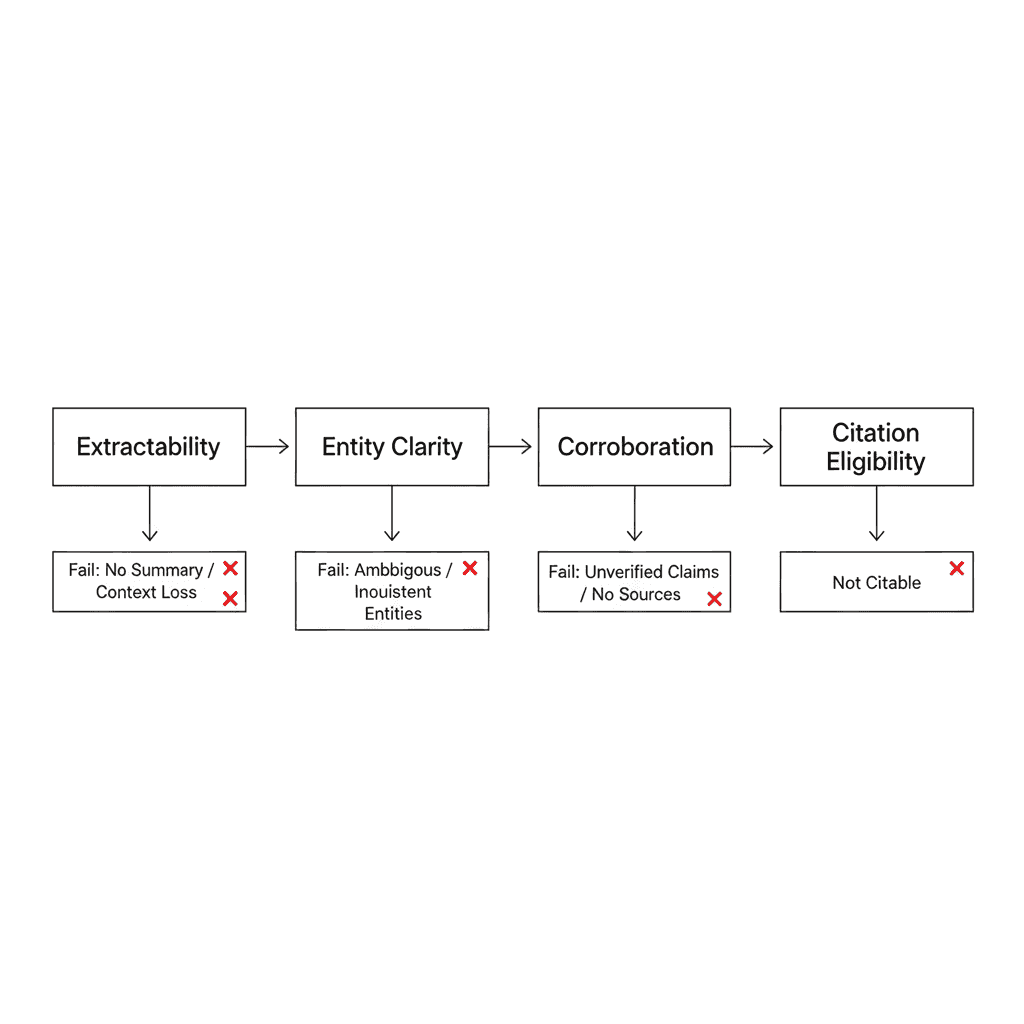
Old Way vs New Way is the operational contrast between “ranking for clicks” and “building structured authority for extraction.”
The old playbook assumed the click was the reward. The new playbook treats the answer as the product.
Control | Old way (click-era SEO) | New way (AI-era SEO) |
|---|---|---|
Target | Keywords first | Entities + intent first |
Winning output | Long-form “ultimate guide” | Modular, extractable answers |
Proof | “We rank #X” | “We are cited + trusted + consistent” |
Content style | Verbose, padded intros | Tight definitions + tables + examples |
Optimization unit | Page | Passage + module + claim |
Authority | Backlinks as primary | Corroboration + reputation graph + mentions |
Refresh | Annual rewrite | Rolling vault refresh tied to claims |
Before/after rewrite example (what changes in AI SEO writing):
Before:
“AI SEO is important because AI is changing search and businesses need to adapt their strategies to stay competitive online.”
After:
“AI SEO is the practice of structuring content so AI systems can extract, verify, and cite it. If your definitions are bounded and your claims have provenance, you can win visibility even when clicks fall.”
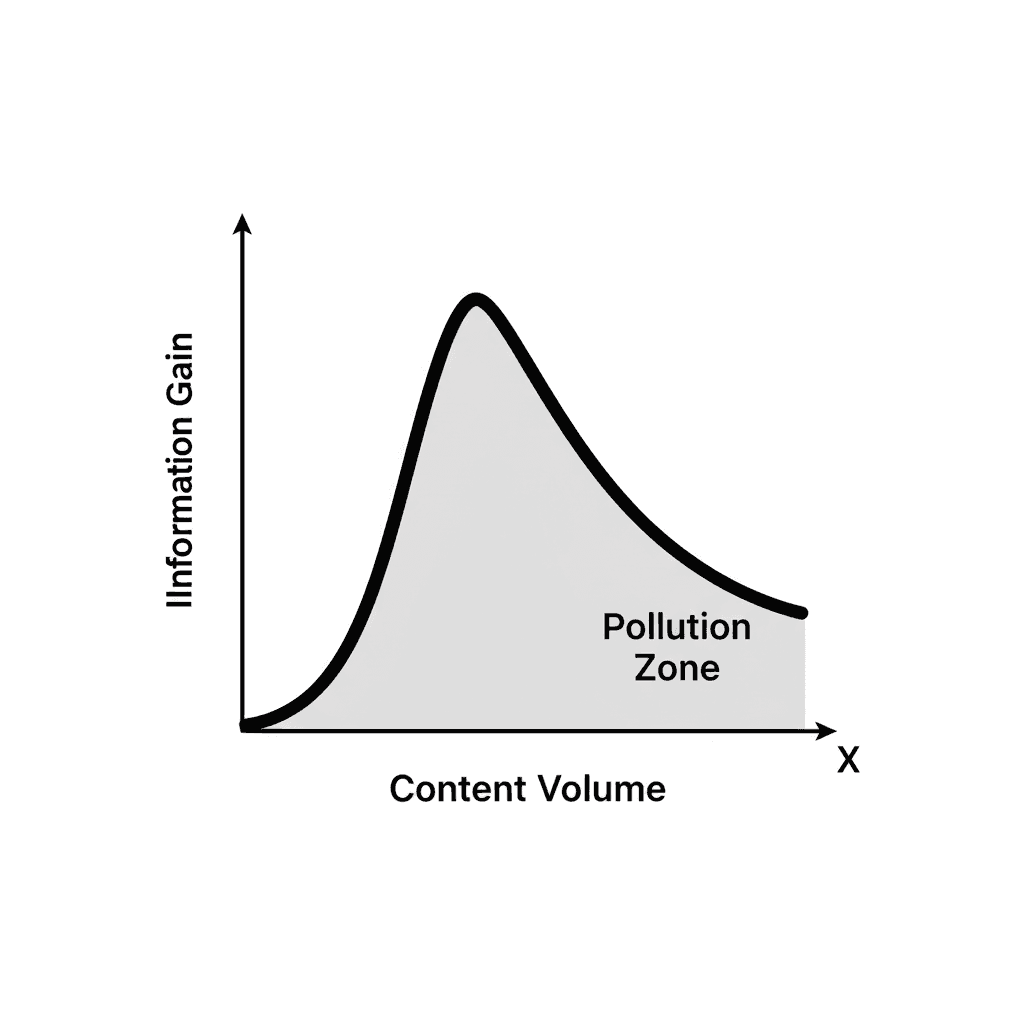
The paradox is the counter-intuitive truth that “more content” can reduce AI visibility when it increases ambiguity, duplication, or unprovable claims.
Most sites lose because they publish more pages that say the same things with different words. That trains systems to treat the topic as commodity.
To win, you do the opposite:
Publish less, but with higher information gain.
Use fewer claims, but make each claim defensible.
Write shorter definitions, but tighter boundaries.
Ship fewer pages, but more modules that can be lifted into answers.
This is why “AI Overviews optimization” is not a checklist you bolt on. It’s a content governance standard.
Definitions (with ★):
what is e-e-a-t and why does it matter for ai search ★
what are ai overviews in google search ★
what is a “citation” in chatgpt or perplexity answers ★
entity vs keyword: what should i target first
what does “search intent” mean in modern seo
How-to workflows (with ★):
how to build an ai-ready content brief (with entities + intent) ★
how to add faq schema and article schema correctly ★
how to refresh content so ai answers stop using old info ★
how to do keyword research using ai without hallucinations
how to map entities to headings (h2/h3) for a hub page
Comparisons ( with ★):
ai seo vs traditional seo: what actually changed ★
ai overviews vs normal serps: where do clicks go ★
aeo vs geo vs seo: what should i prioritize ★
e-e-a-t vs backlinks: which matters more for trust
semrush vs ahrefs for ai overview research
Problems (with ★):
how do i fix entity coverage gaps in my content ★
why is my page ranking but not getting cited in ai answers ★
how do i diagnose “mismatched serp” for an ai-era query ★
why does my content look correct but gets misquoted by ai
how to fix thin content without adding fluff
Freshness (with ★):
what changed in ai overviews in 2025 and what to do now ★
does google have guidelines for ai features and websites ★
how often should i refresh content for ai answers ★
what happens to bottom-funnel queries in ai overviews
what’s the relationship between “ai mode” and ai overviews
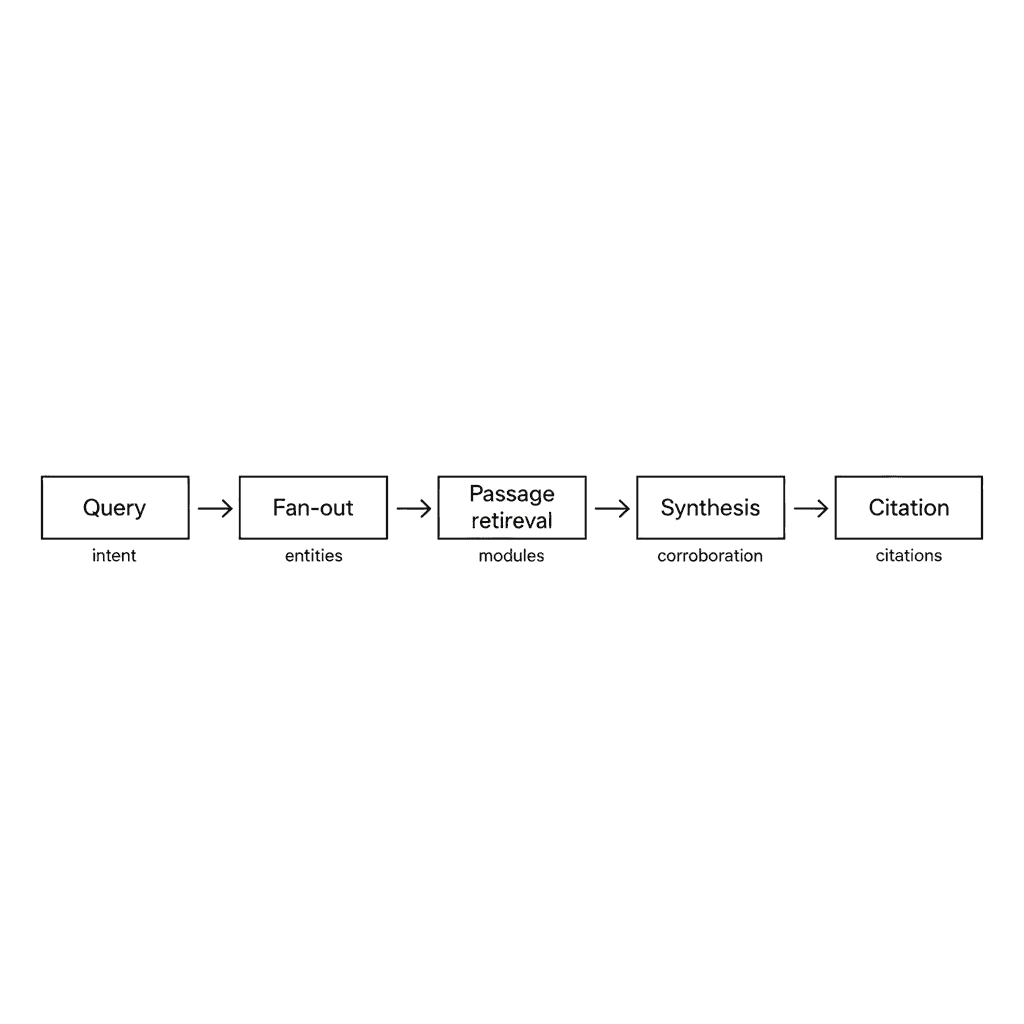
The reputation graph is the network of entity relationships and corroborating signals that teaches systems who you are, what you’re credible about, and whether your claims are safe to repeat.
AI systems do not “trust your page.” They trust patterns:
Your brand entity appears consistently with the same topics.
Independent sources corroborate similar claims.
Your content uses stable definitions and avoids contradictions across pages.
Your site demonstrates ongoing maintenance (freshness + corrections).
Two practical implications:
You need a controlled glossary so your internal language doesn’t fragment your entity signals.
You need off-site corroboration pathways (mentions, citations, consistent profiles) so your claims aren’t isolated.
This aligns with how Google talks about AI Overviews: they are designed as snapshots with links to explore more, which implies selection pressure toward sources that are safe to point users to.
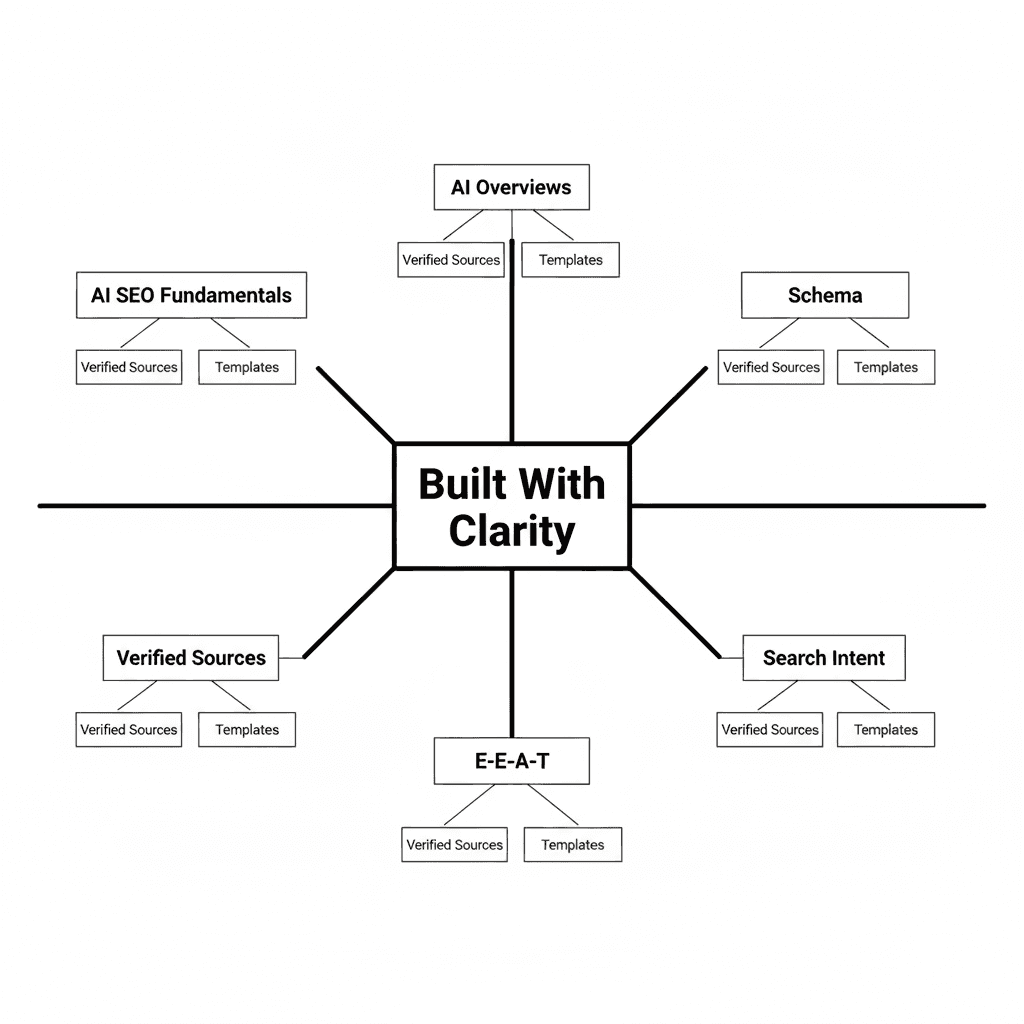
The citation vault is a lightweight system that stores the few numbers and claims your content depends on, with dates, sources, and limitations—so your pages stay true as models and SERPs change.
This is non-negotiable in 2025 because the SERP is unstable and the AI layer is moving:
Semrush reported that from October to December 2024, the share of keywords triggering AI Overviews rose for lower-funnel intents: commercial from 8.15% to 18.57%, transactional from 1.98% to 13.94%, and navigational from 0.84% to 10.33% (Semrush, published 2025-12-15). Semrush
Ahrefs reported that AI Overviews reduced clicks by 34.5% in its study (Ahrefs, published 2025-04-17). Ahrefs+1
Ahrefs also documented a CTR shift: for “AI Overview keywords,” average position-one CTR dropped from 0.073 (March 2024) to 0.026 (March 2025) (Ahrefs, published 2025-04-17). Ahrefs
Google’s own product communications describe expanding AI Overviews and introducing AI Mode (Google, published 2025-03-05). blog.google
Citation behavior can diverge from rankings: industry summaries cite research indicating a large portion of LLM citations may not rank in Google’s top 100 for the original query (Ahrefs research as referenced by Position Digital, updated 2025-12-21). Position Digital
Vault-ready stats table (use this as your “truth backbone” for the hub):
Statistic
Measures
Date range / date
Source
Limitation
8.15% → 18.57%
Commercial-intent keywords triggering AI Overviews
Oct–Dec 2024
Semrush
Sample/market constraints; rollout dynamics
1.98% → 13.94%
Transactional-intent keywords triggering AI Overviews
Oct–Dec 2024
Semrush
Vertical bias possible
0.84% → 10.33%
Navigational-intent keywords triggering AI Overviews
Oct–Dec 2024
Semrush
Rapid changes post-launch
34.5%
CTR/click reduction associated with AI Overviews
Study published Apr 2025
Ahrefs
Aggregated effect; not every query behaves the same
0.073 → 0.026
Avg position-one CTR change for “AI Overview keywords”
Mar 2024 → Mar 2025
Ahrefs
Specific cohort definition matters
1.5B+ monthly users
Reported scale of AI Overviews usage
Q1 2025
Ahrefs
Depends on Google’s rollout/definitions
1.76% → 0.61%
Organic CTR drop cited for queries with AI Overviews
Jun 2024 → Sep 2025
Onely
Method depends on query set and SERP tracking
“80%”
LLM citations not ranking in Google top 100 (as summarized)
Aug 2025
Position Digital (citing Ahrefs)
Secondary reporting; track back to primary where possible
“80% shift”
Volatility claim about LLM sources changing fast
Updated Nov 2025
Backlinko
Methodology/definition of “sources” varies
One plain-text vault row example (copy/paste standard):
Vault Row:
Claim: “AI Overviews reduce clicks to websites by 34.5%.”
Metric type: CTR impact
Date: 2025-04-17
Source: Ahrefs (study)
Scope: Observational; compares cohorts with/without AIO behavior
Limitation: Aggregated; effect varies by intent and SERP layout
Where used: AI SEO Fundamentals hub → Citation Vault section; CTR discussion
The execution phase is the production model that turns AI SEO fundamentals into repeatable shipping: definition control, structure control, failure control, and freshness control.
Production scene (what this looks like in real life):
A Head of Growth sees a traffic dip on an informational cluster. Rankings are stable. Conversions are down. The “issue” isn’t content quality—it’s that AI Overviews are absorbing the early journey, and the remaining clicks are later-stage users. The fix is not more posts. The fix is tighter modules, clearer intent, and evidence-backed claims.
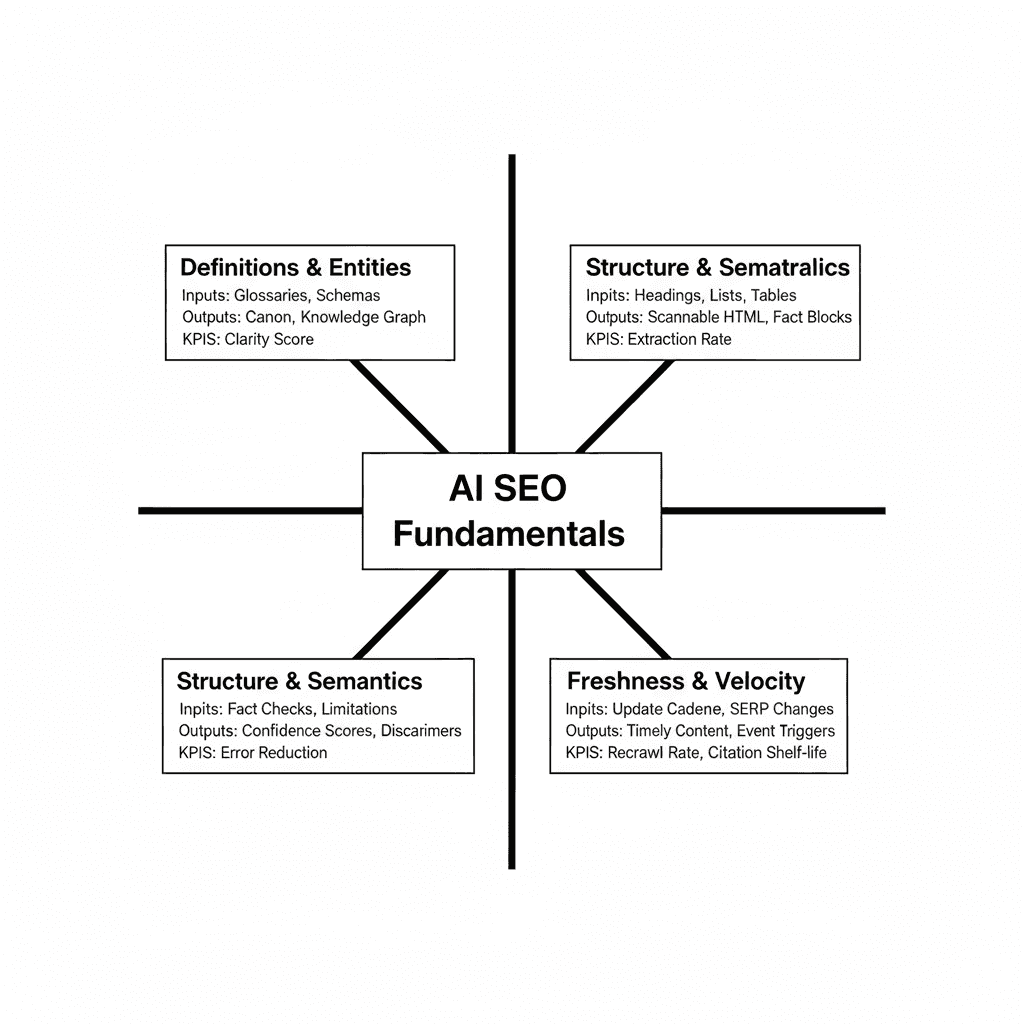
FAQ extraction is the use of tightly written Q/A blocks to supply clean, bounded answers that AI systems can reuse without distortion.
Q: What is AI SEO?
A: AI SEO is the discipline of structuring and validating your site so search engines and AI answer systems can reliably extract, summarize, and cite it—while still earning traditional rankings.
Q: What are AI Overviews and why do they change SEO?
A: AI Overviews are AI-generated snapshots in Google Search that synthesize information from multiple sources. They change SEO because visibility now includes being extracted and cited, not just being clicked.
Q: What is an LLM citation in search?
A: An LLM citation is a source reference or link an AI system attaches to a generated answer to support claims. Citations tend to reward clear definitions, scannable structure, and corroborated facts.
Q: What is the fastest way to improve AI visibility without publishing more content?
A: Improve extractability and trust first: tighten definitions, add comparison tables, implement relevant schema, and refresh key claims with a small citation vault that logs sources, dates, and limitations.
References & verified data is the source ledger that backs the hub’s hard claims and definitions, with URLs stored here only.
[1] Google Search Central: AI features and your website: what AI features are and how site owners should think about inclusion. Google for Developers
[2] Google Help: AI Overviews: user-facing definition of AI Overviews as AI-generated snapshots with links. support.google.com
[3] Google Blog: Expanding AI Overviews and introducing AI Mode (Mar 5, 2025): official rollout/positioning update. blog.google
[4] Semrush: AI Overviews study/report (Dec 15, 2025): intent distribution shifts (8.15%→18.57%, 1.98%→13.94%, 0.84%→10.33%). Semrush
[5] Ahrefs: AI Overviews reduce clicks by 34.5% (Apr 17, 2025): CTR/click impact and CTR cohort changes (0.073→0.026). Ahrefs
[6] Ahrefs: Google AI Overviews overview: additional context and supporting stats (includes 34.5% reduction reference). Ahrefs
[7] Search Engine Land: Thriving in AI search starts with SEO fundamentals (Sep 30, 2025): argument and framing for fundamentals-first visibility in AI search. Search Engine Land
[8] Search Engine Land: Good GEO is good SEO guide (Nov 18, 2025): GEO framing as fundamentals + structure. Search Engine Land
[9] Search Engine Land: “Good SEO is good GEO” quote coverage (Sep 2, 2025): industry reporting on Google’s “good SEO is good GEO” messaging. Search Engine Land
[10] Position Digital: AI SEO statistics (Updated Dec 2025): citation/ranking divergence stats as summarized (trace back to primary research where possible). Position Digital
[11] Backlinko: LLM sources shifted 80% in 2 months (Updated Nov 7, 2025): volatility framing for citation churn. Backlinko
[12] Onely: CTR drop example (Dec 1, 2025): CTR drop figure used as an example of structural change and refresh rationale. Onely
[13] OverCoffee Consulting: SEO checklist 2025: example of extractable checklist formatting patterns that tend to win. Boutique Marketing Agency